Is Your Success Masking Your Struggle? 5 Signs of High-Functioning Anxiety in Englewood Women
Think back to last weekend. You are sitting on a sunny patio in Lone Tree with friends, laughing and catching up. But the moment you get home, the silent reel starts playing in your mind.
“Did I say too much?”“Do they actually enjoy my company, or are they just being nice?” You spend hours picking apart a perfectly normal afternoon until you feel completely drained.
To everyone else, you look entirely put-together. You are successful, dependable, and organized.
Inside, though, it feels like you are slowly drowning under the weight of your own life.
If this sounds familiar, you aren't alone, and nothing is wrong with you.
You are likely experiencing high-functioning anxiety, a pattern of survival I work with daily in my anxiety counseling in Englewood, CO.
Key Takeaways
Anxiety can look like overdrive: High-functioning anxiety is an active stress response that drives hyper-productivity rather than freezing.
Stress hides in your muscles: Emotional over-functioning frequently registers as physical tension, like tight shoulders and a clenched jaw.
The Talk Therapy Trap: Highly articulate women often analyze their stress without releasing it, meaning talk alone rarely solves the issue.
Working with the nervous system: Accessing the body directly through Brainspotting helps reset deep-seated survival reflexes.
The Bottom Line:High-functioning anxiety is what happens when you carry intense internal worry (like second-guessing, perfectionism, and muscle tension) while maintaining a successful outward life. It is your nervous system's way of over-functioning to find safety, rather than shutting down.
What is High-Functioning Anxiety?
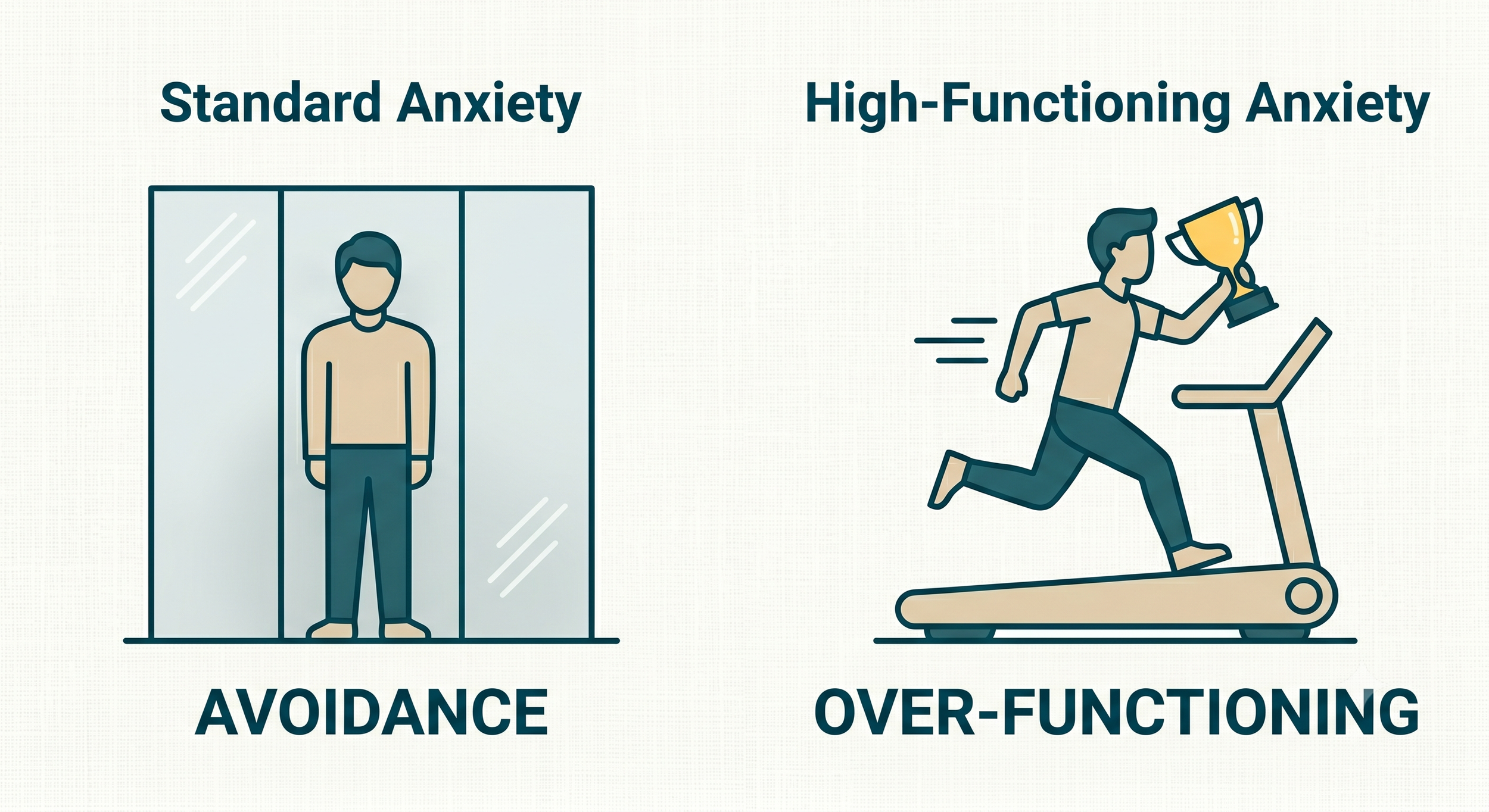
We usually think of anxiety as panic attacks, avoidance, or hiding under the covers.
But when anxiety is high-functioning, it doesn't freeze you. It mobilizes you.
Your worry becomes a high-octane fuel that drives you to work longer hours, plan for every disaster, and keep everyone happy just to feel safe.
The National Institute of Mental Health (NIMH) doesn't classify this as a standalone disorder in the DSM-5, but it is a very real way that many high-achieving women suffer.
| Feature | Standard Worry (Generalized) | High-Functioning Anxiety |
|---|---|---|
| Primary Coping Style | Hiding away, putting things off, social withdrawal. | Over-scheduling, perfectionism, hyper-productivity. |
| How Others See You | Visibly overwhelmed, detached, or struggling. | Confident, highly organized, always reliable. |
| Where it Lives in the Body | Panic feelings, shaking, general fatigue. | Jaw clenching, tight shoulders, chronic headaches. |
| How We Treat It | Exposure, changing behaviors, self-regulation. | Nervous system regulation, subcortical processing, parts-work. |
The Englewood Mirror: Why South Denver’s Culture Fuels the "Over-Functioning" Loop
In my Lone Tree therapy office, I work with this specific pattern every day.
The women who sit on my couch are often directors in the Denver Tech Center, active moms, and community leaders from Greenwood Village, Centennial, and Lone Tree.
South Denver is a beautiful place to live, but its pace is relentless.
There is an unspoken rule here that you must be highly successful, deeply involved, and perfectly fit, all while making it look completely effortless.
We run ourselves ragged trying to live up to this standard, caring for everyone else while ignoring our own limits.
Clinical Insight: High-achieving professional hubs, such as the Denver Tech Center (DTC) and South Denver suburbs, reward constant productivity. These local cultural factors frequently mask deep internal burnout, turning chronic nervous system stress into socially praised achievements.
5 Telling Signs of High-Functioning Anxiety in Women
How do you know if you are simply a motivated high-achiever or if you are running on the fumes of high-functioning anxiety?
Recognizing the difference between healthy drive and an anxiety-driven survival response is the first step toward getting your peace back.
Here are five signs I frequently help women work through.
1. The Productivity Addiction
Your worth is tied to what you got done today.
If you try to sit on the couch on a Sunday, a heavy layer of guilt settles in.
You only feel safe when you are crossing things off a list.
2. The Perfectionist’s Shield
You use flawless work, neat outfits, and packed calendars to keep criticism at bay.
Underneath is a quiet, constant whisper: If I drop one ball, everyone will realize I'm failing.
You feel that if you slip up, the whole system will collapse and others will see you as "not enough."
3. The People-Pleasing Trap
Saying yes to every school bake sale, extra project, or family favor becomes your default setting.
You are exhausted, but the fear of disappointing someone else is worse than the exhaustion itself.
If you are stuck in this loop, my guide on counseling for people-pleasing looks closer at how to break this cycle without the guilt.
4. The Calm Exterior vs. Chaotic Interior
People tell you they do not know how you manage to always look so calm.
You smile, but inside your head is a crowded room of worst-case scenarios, endless "what-ifs," and replayed conversations.
Your mind remains on high alert, preparing for the next emergency.
5. Somatic Clenching: The "Inverness Drive Jaw"
Anxiety isn't just in your head (it settles in your muscles).
Many women come into my office and realize their shoulders are practically touching their ears.
I call it the "Inverness Drive Jaw"—the physical price of holding everything together.
Your body tells the truth even when you try to ignore it.
A report by Harvard Health Publishing points out that chronic anxiety frequently shows up as physical pain, tight muscles, and digestive issues.
A Quick Reality Check
Take a quiet moment to look at your daily habits.
If these ring true, your nervous system is likely locked in a chronic state of survival:
Are you checking your work inbox at 11:00 PM because leaving an unread email feels dangerous?
Do you find yourself dissecting the tone of a simple text message for hours?
Are you physically exhausted when you climb into bed, but your brain refuses to shut down?
Do you spend hours over-preparing for a simple meeting, just in case?
You do not have to carry this invisible weight alone. If you recognize your own reflection in these signs, please know you aren't broken.
Let's see if I can help you find your breath again.
Schedule a complimentary 15-minute consultation with me today.
The "Talk Therapy Trap": Why You Can’t Always Think Your Way Out of Anxiety
Here is an uncomfortable truth that usually brings my clients an immediate sense of relief: You cannot talk your way out of anxiety because logical self-awareness does not change physical survival patterns.
High-functioning women are usually brilliant, articulate, and highly self-aware.
But if you've tried traditional talk therapy and felt like it didn't stick, here is why.
You are so good at analyzing your thoughts that you can talk circles around the issue, yet your body still feels like it is on fire.
In my clinical experience, the smarter a woman is, the more easily she can use self-awareness to avoid actual emotional processing.
This is what I call the Talk Therapy Trap.
Anxiety doesn't live in your logical prefrontal cortex.
It is stored in the deeper, non-verbal parts of your brain and your nervous system.
When you are stuck in an anxiety loop, your body is reacting to an old survival signal, and no amount of rational thinking can turn that off.
How Your Brain Handles Worry: High-functioning anxiety is wired into your subcortical brain and nervous system. Because this area does not process language, cognitive talk therapy alone rarely resolves the root cause. Somatic approaches like Brainspotting are used to help release this stored survival loop directly from the body.
Moving Deeper with Brainspotting
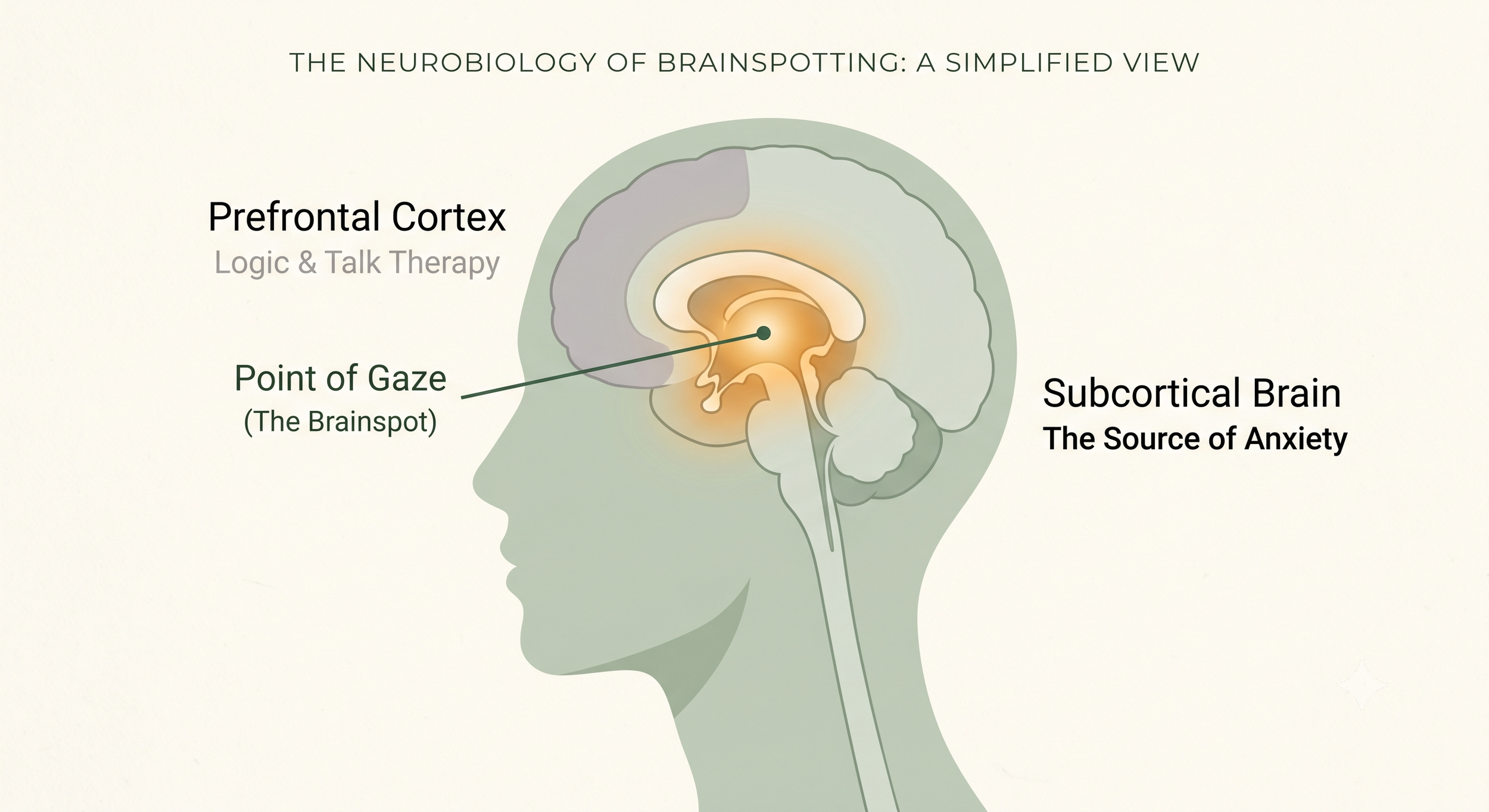
To stop over-functioning, we must go where the stress is actually stored.
This is why I brought specialized Brainspotting therapy in Englewood into my practice.
Brainspotting is a powerful, brain-body-based therapeutic method.
It works by using your visual field to locate "brainspots" (specific eye positions that correlate to where emotional pain or anxiety is physically held).
Instead of just talking about your anxiety, we use Brainspotting to:
Access the deep, non-verbal areas of your brain.
Gently process and release the physical charge of your anxiety.
Rewire your nervous system’s default response from fight-or-flight to grounded safety.
A study on subcortical trauma processing indicates that where you look affects how you feel.
Visual focus points tap into deep midbrain pathways to reset our survival reflexes, bypassing our cognitive filters entirely.
Additionally, a 2022 comparative study on somatic techniques showed that body-centered focus points are highly effective for accelerating emotional regulation and nervous system integration.
If you are curious about how I structure these sessions, feel free to explore my frequently asked questions for deeper details.
Healing the High-Achiever: Attachment-Based Care at Anchor Point Counseling
Your drive to be perfect probably started as a very smart survival strategy when you were younger.
You might have learned early on that achieving, keeping quiet, or staying organized was the safest way to get love and feel secure.
At Anchor Point Counseling, my goal isn't to strip away your drive or make you less motivated.
We use attachment-based care and Emotionally Focused Individual Therapy (EFIT) to help you understand and heal the relational roots of your anxiety.
My approach aligns with the attachment principles of the International Centre for Excellence in Emotionally Focused Therapy (ICEEFT).
We focus on helping you feel secure within yourself and your relationships so you can set boundaries without the heavy weight of guilt.
Frequently Asked Questions About Anxiety Counseling in Englewood
Can high-functioning anxiety be cured, or is it just who I am?
High-functioning anxiety is not an unchangeable personality trait; it is a highly conditioned coping mechanism. Through targeted nervous system regulation and therapies like Brainspotting, you can retrain your brain to feel safe without relying on constant over-functioning.
How is high-functioning anxiety different from being a high-achiever?
A healthy high-achiever is motivated by passion, joy, and values, and can easily rest and celebrate their wins.
A person with high-functioning anxiety is driven by a fear of failure, shame, or rejection, and experiences resting as an unsafe or guilt-inducing state.
Do you offer online therapy sessions for anxiety in Colorado?
Yes.
While my physical office is located at 14 Inverness Dr E #C-230, Englewood, CO, I provide HIPAA-compliant virtual therapy sessions to women residing anywhere within the state of Colorado.
How many Brainspotting sessions will I need before I start feeling a difference?
Because Brainspotting works directly with the deep, survival-based areas of the nervous system, many women report experiencing a physical release or shift in their anxiety levels within their first three to five sessions. However, healing is not a linear checklist. The total number of sessions depends on your unique history, how long your nervous system has been running on empty, and what feels safest for your body.
What if my background is complicated or I prefer a strictly clinical approach?
Your therapy is always entirely your own. I provide a warm, faith-integrated space for women who find strength in their spiritual worldview, particularly those navigating the intense perfectionism that can sometimes arise in faith communities. That said, spiritual integration is completely optional. If you prefer a strictly clinical, somatic focus, I meet you exactly where you are with deep respect for your boundaries and goals.
Reclaim Your Peace of Mind
You don't have to keep carrying the weight of South Denver on your shoulders.
Over-functioning is exhausting, but it is a pattern you can change.
If you are ready to stop managing your anxiety and start working with your nervous system, let's talk.
About the Author
Stephanie Johnson, LMFT is a Licensed Marriage and Family Therapist (License #MFT.2080) and the founder of Anchor Point Counseling, PLLC in Englewood, Colorado. With extensive advanced clinical training in Emotionally Focused Therapy (EFT) and Brainspotting, Stephanie specializes in providing attachment-based, trauma-informed care for high-achieving women. Her practice operates with a neuro-affirming, compassion-driven mission designed to help women process subcortical stress, re-establish personal boundaries, and build secure relationships with themselves and others. Learn more about her credentials and clinical philosophy on her professional biography page.
Disclaimer: The information provided in this article is for educational and informational purposes only and is not intended to serve as professional medical advice, psychiatric diagnosis, or clinical treatment. Always consult with a licensed mental health clinician or qualified healthcare professional regarding any cognitive, emotional, or physical health symptoms.
Crisis Support & Emergency Resources:
If you or someone you know is struggling with a mental health emergency or experiencing thoughts of self-harm, please utilize the following free, confidential, 24/7 support lines immediately:
National Suicide & Crisis Lifeline: Call or text 988
Crisis Text Line: Text HOME to 741741
Emergency Services: Call 911 or report directly to the nearest hospital emergency room.