Brainspotting 101: How to Heal Trauma Without the Talk
Have you ever spent an evening laughing with close friends, having a genuinely great time, only to go home and immediately spiral?
"Do they really like me?" "Why did I say that?" "What if they are secretly annoyed with me?"
Your mind replays every single moment from the last 24 hours, and the internal overwhelm becomes too much to carry. You try to tell yourself that you are safe, that everything is fine, and that there is no logical reason to worry. But your body isn't listening. Your chest feels tight, your breathing is shallow, and your heart is racing.
In my clinical practice as a licensed therapist (LMFT #MFT.2080) in Englewood, Colorado, I see this exact pattern every single day. I work with high-achieving, over-giving women who are incredibly self-aware. They have done self-help work and spent years in traditional talk therapy. They know exactly why they feel anxious, and they can trace their people-pleasing patterns right back to childhood.
Yet, they still feel entirely stuck.
If this sounds familiar, I want you to take a deep breath. This isn't your fault. It is conditioning. And it is completely changeable. The reason you still feel anxious despite having high emotional intelligence is simple: your anxiety doesn't live in the logical, thinking part of your brain.
It lives in your survival brain. To heal it, we have to move past the talk.
Key Takeaways
Bypasses the "Insight Loop": Traditional therapy works with the logical prefrontal cortex. Brainspotting targets the midbrain, where physical anxiety and trauma are actually stored.
No Retelling Required: You do not have to endlessly talk about or relive painful past events to experience deep, lasting neurological relief.
Gentle and Self-Regulating: Because it is entirely body-led, your brain processes stress at its own organic, safe pace without overstimulating your system.
What is Brainspotting and How Does It Work?
When we experience overwhelming stress, chronic burnout, or trauma, our brains cannot always process the experience fully. Instead of being filed away as a past memory, that survival-state energy gets "stuck" in our autonomic nervous system and subcortical brain.
This is the deeper area of your brain responsible for survival, reflexes, and raw emotional processing. By finding a specific physical eye position that correlates with where you carry stress, we access the deep, subcortical brain where trauma lives.
Brainspotting, discovered in 2003 by Dr. David Grand, operates on a simple, scientifically profound premise: where you look affects how you feel.
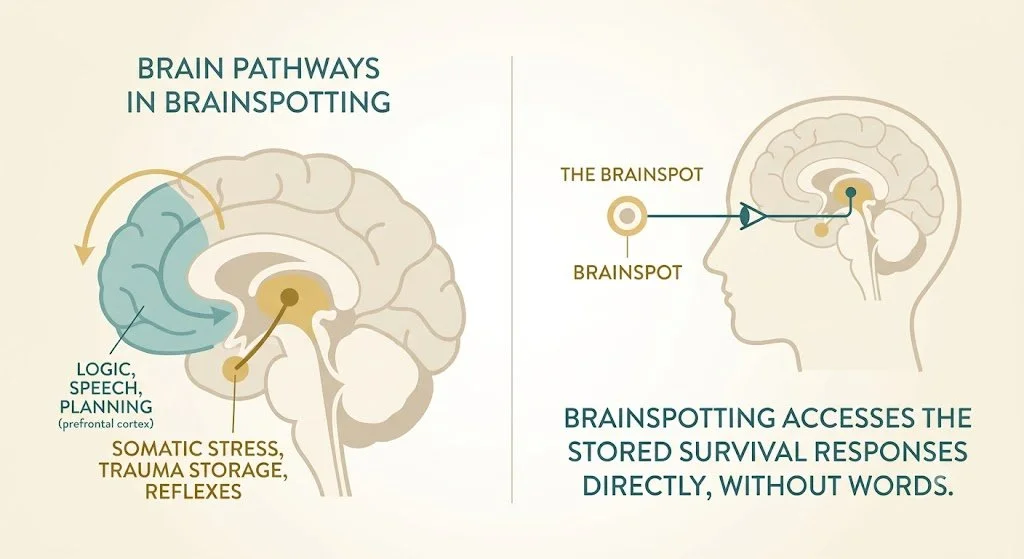
During a session, we collaborate to find a physical eye position that matches where you are holding emotional or physical tension in your body. This eye position acts as a direct neurological doorway to the exact area of your brain where that stress is stored.
By holding our gaze on this "brainspot," we allow the brain and body to process the unprocessed material from the inside out. If you are tired of talking in circles and want to experience what somatic healing feels like, you can explore my specialized Brainspotting for Trauma and Anxiety Therapy Services.
Brainspotting vs. EMDR vs. Talk Therapy: Finding Your Path
When women come to my Englewood counseling office looking for somatic therapy, they often ask how Brainspotting compares to other modalities.
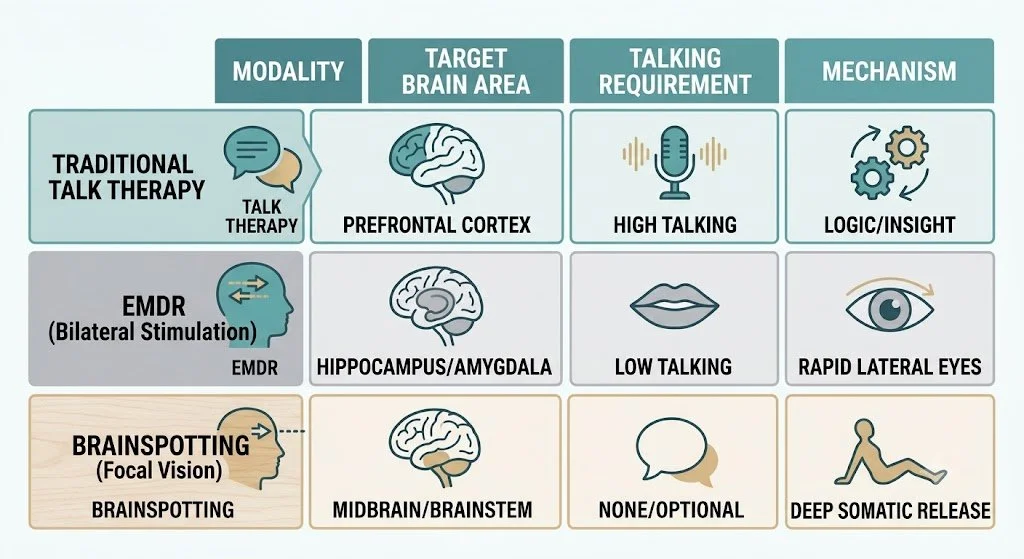
They want to know how it differs from EMDR (Eye Movement Desensitization and Reprocessing) or traditional talk therapy. While traditional therapy focuses on analyzing your thoughts, somatic approaches like Brainspotting target your physical nervous system to resolve stress at its neurological root.
Each approach has distinct benefits, but they target entirely different areas of your nervous system:
| Feature / Modality |
Traditional Talk Therapy | EMDR Therapy | Brainspotting |
|---|---|---|---|
| Primary Brain Target | Prefrontal Cortex (Cognitive, Analytical) | Midbrain & Hemispheres (Subcortical) | Midbrain & Autonomic Nervous System (Subcortical) |
| How It Accesses Stress | Verbal processing, analyzing, and reframing thoughts | Rapid bilateral eye movements and structured protocols | Fixed, sustained eye gaze (holding a single "brainspot") |
| Verbal Demands | Very High (requires telling and retelling the story) | Medium (requires structured, periodic cognitive check-ins) | Very Low (focuses entirely on internal bodily processing) |
| Pacing & Setup | Led by cognitive insight and therapist direction | Led by strict, rigid clinical protocol steps | Led entirely by your body's organic self-regulating wisdom |
Bypassing the "Insight Trap"
Traditional talk therapy is wonderful for building self-awareness, but insight alone does not change a dysregulated nervous system. You cannot logic your way out of a panic attack, and you cannot think your way out of chronic burnout.
EMDR is highly effective for trauma, but it relies on strict, rapid eye-movement protocols that can sometimes feel overly clinical, rigid, or overstimulating for highly sensitive systems.
Brainspotting is gentler, highly customized, and deeply intuitive. Because we find a fixed point of gaze and hold it, your brain is given the quiet space it needs to scan, locate, and resolve its own pain at a safe pace.
The Science of the "Stuck" Nervous System
To understand why Brainspotting is so effective, we have to look at the natural hierarchy of your brain.
When your body is stuck in a chronic state of fight, flight, or freeze, no amount of logical thinking from your prefrontal cortex can force your nervous system to calm down.
When you are stuck in a people-pleasing loop (always saying yes, over-functioning, and ignoring your own boundaries), your survival brain is usually in charge.
Your subcortical brain associates saying "no" or taking up space with a loss of safety, connection, or belonging. This is a somatic response where your body goes into an active freeze or fawn state.
Your heart rate rises, your muscles tense, and you feel an urge to fix everything just to make the discomfort stop. Brainspotting targets the midbrain directly to quiet this alarm system. By locating the brainspot associated with that somatic panic, we can discharge the physical tension.
This process retrains your nervous system to realize that you are actually safe to set boundaries, safe to rest, and safe to say no. Curious about how this clinical approach can help you reclaim your voice? Reaching out to chat about your goals is completely free, and exploration is never a commitment. Book a free consultation call.
What Does a Brainspotting Session Actually Feel Like?
If you have never experienced somatic therapy, the process can sound a bit mysterious. It is normal to feel skeptical or even a little nervous about trying something new in therapy.
A typical Brainspotting session is collaborative, deeply grounding, and designed to flow at a pace that feels completely safe for your system.
In my comfortable, warm Lone Tree office (or via my secure online therapy platform across Colorado), a typical session flows through these steps:
Locating the Felt Sense: We talk briefly about what is bringing you pain, anxiety, or burnout, identifying where you physically carry that stress.
Finding the Pointer Spot: We gently track your eyes across your field of vision using a pointer to find the exact point that correlates to that physical feeling.
Holding the Spot and Processing: You hold your gaze on that pointer while using bilateral sound (gentle music in headphones) to stimulate and balance your brain.
Body-Led Integration: You observe whatever thoughts, physical sensations, memories, or emotions arise without needing to talk or explain.
Is Brainspotting Right for You? (The Somatic Checklist)
Somatic processing is particularly transformative for high-achieving women who are tired of talking in circles and ready to release physical tension.
You might be an ideal candidate for Brainspotting if you experience:
The Insight Loop: You have spent years in talk therapy and can explain why you have anxiety, but you still experience the physical symptoms of trauma.
The People-Pleasing Trap: You feel an intense, physical wave of anxiety, guilt, or dread whenever you try to say "no" or set a boundary with someone.
Chronic Burnout and Fatigue: Your body feels constantly "on edge" or exhausted, and traditional coping strategies like mindfulness or journaling no longer work.
Somatic Tension: You carry persistent physical tension (such as chest tightness, shallow breathing, jaw-clenching, or stomach distress) that flares up with stress.
Frequently Asked Questions About Brainspotting
Is Brainspotting safe for highly sensitive people?
Yes, it is highly recommended for sensitive nervous systems. Because the processing is entirely body-led and organic, your brain determines its own safe, natural speed of healing. I do not force your system to go faster or deeper than it is ready to handle.
Do I have to talk about what happened to me during a session?
No, you do not have to recount your painful memories. While we identify the emotional target, your subcortical brain does the heavy lifting of processing without requiring verbal explanation. You only share what feels comfortable, which prevents emotional overwhelm.
How many sessions does it take to feel a shift?
Many clients begin to feel a distinct physical release and relief within 3 to 6 sessions. For deep-seated childhood conditioning or complex trauma, ongoing somatic work allows for a safe, integrated transformation over time.
What if I struggle to keep my eyes focused or feel "bad" at concentrating?
There is no "wrong" way to do Brainspotting. If your eyes naturally wander or you feel restless, that is simply your nervous system processing, and we work collaboratively with whatever your body does. My role is to maintain a supportive, non-judgmental space for whatever comes up.
Can Brainspotting be done virtually, or does it have to be in-person?
It is incredibly effective both ways. Whether we meet in my Lone Tree therapy room or via a secure video session, we utilize virtual pointer tools and specialized sound therapy to achieve the exact same neurological results.
How is Brainspotting different from mindfulness or meditation?
Mindfulness and meditation help you manage and sit with your current stress. Brainspotting is an active, clinical neurobiological tool that locates the specific root of your stress to process and discharge it from your nervous system entirely.
Moving Forward: Grounding Your Healing in Reality
Unlearning a protective habit that has kept you safe for decades takes time. It does not happen overnight, and it cannot be forced.
You do not have to keep giving from an empty cup, and you do not have to shrink, over-function, or carry the emotional weight of everyone around you until you disappear. Healing does not require you to endlessly relive your painful memories or talk your way through every historical trigger.
Your body already knows how to process stress. It simply needs the right environment and clinical tools to release what it has been carrying. If you are ready to stop just coping with your anxiety and start genuinely resolving it, I would love to walk this path alongside you.
I work with women in-person at my counseling office in Lone Tree, Colorado (serving Lone Tree, Englewood, Denver, and surrounding South Denver communities), as well as virtually for clients throughout the state of Colorado.
Schedule a complimentary consultation call today. Let's help you find your way back to yourself.
About the Author
Stephanie Johnson, LMFT (#MFT.2080) is a licensed therapist, clinical guide, and the founder of Anchor Point Counseling Co. in Englewood, Colorado. With over 7 years of specialized clinical experience supporting high-achieving, over-functioning women, Stephanie is passionately committed to helping clients heal trauma, quiet chronic anxiety, and set healthy boundaries. She bridges the gap between deep somatic neuroscience and warm, heart-centered care to help women step into true alignment. Learn more about her background and approach on Stephanie's full bio page.
Medical Disclaimer: The information provided in this article is for educational and informational purposes only. It is not intended to serve as a substitute for professional medical or mental health advice, clinical diagnosis, or specialized treatment. Always seek the advice of your qualified mental health professional or primary care provider with any questions you may have regarding a psychological or physical condition.
Crisis Support Resource Directive: If you or someone you know is struggling or in crisis, help is available. You are not alone. Please reach out to one of the following free, confidential resources available 24/7:
Suicide & Crisis Lifeline: Call or text 988
Emergency Services: Call 911 or go to the nearest emergency room
Crisis Text Line: Text HOME to 741741 to connect with a crisis counselor
