Stopping the Cycle: A Guide to Healing from People-Pleasing & Burnout
You pour yourself into your work. You hold the family together. You anticipate what everyone else needs before they even realize they need it.
But inside? You are bone-tired.
To the world, you look like the woman who has it all together. Behind closed doors, your mind spins, your shoulders feel like concrete, and you are running on empty.
This isn't just a heavy week; it's a systemic crash. If you've spent years keeping everyone else happy at the cost of your own peace, you aren't just tired. You are dealing with deep, physiologicalchronic burnout and nervous system exhaustion.
Key Takeaways
The Root Cause: People-pleasing isn't a harmless personality trait. It is an active, stress-inducing survival response (fawning) that constantly drains your physical energy.
The Autonomic Trap: Hyper-vigilance and constantly monitoring other people's moods keep your nervous system on high alert, causing physical exhaustion.
Talk Therapy Limitations: Standard cognitive tools (like CBT) often fail during moments of boundary panic because intense stress takes your logical brain offline.
The Somatic Cure: Modalities like Brainspotting and EFIT work from the bottom up, clearing stress triggers out of the deep, subcortical nervous system.
A Gentle Path Forward: Healing starts with physical pauses, buying yourself time with simple buffer scripts, and respecting your body's warnings.
The Hidden Link: How Does People-Pleasing Directly Cause Chronic Burnout?
In my Englewood, CO counseling practice, I sit across from brilliant, high-achieving women every single day who ask me the same question: "Why do I feel so exhausted when I love the people I'm helping?"
The answer is simple, yet heavy: People-pleasing is not a personality trait; it is an autonomic, continuous survival-based energy drain.
When your sense of safety is tied to keeping the peace, you are constantly scanning your environment for threats. You analyze the tone of a brief email, track the subtle micro-expressions of your partner, or anticipate the unvoiced expectations of your boss. This hyper-vigilance keeps your adrenal system on constant high alert — a pattern well-documented in research on chronic stress and the HPA axis.
Over time, this behavioral pattern creates a predictable, devastating loop that I call The Over-Giver's Exhaustion Cycle:
The Over-Responsibility Phase: You take on projects, emotional burdens, or schedule demands that belong to someone else.
The Silent Resentment Phase: You carry the load, but a quiet, bitter frustration grows because no one is matching your effort.
The High-Functioning Anxiety Phase: To hide that frustration and maintain safety, your brain spins in circles trying to control every outcome.
The Total Burnout Phase: Your nervous system collapses into emotional numbness, physical fatigue, and heavy brain fog.
The Guilt Loop: You feel guilty for being exhausted, so you over-compensate by saying "yes" again, restarting the wheel.
If you recognize this loop, please know this: You are not broken, and this is not your fault. This is a survival adaptation that we can untangle together.
If you are ready to explore how to step off this wheel, you can learn more about my specialized Therapy for People-Pleasing in Englewood, CO.
The Survival Instinct: Why Can't You "Just Say No" to Over-Functioning?
If healing from people-pleasing were as simple as reading a self-help book or practicing a "power pose" in the mirror, you would have solved this years ago.
You know, logically, that you need to say no. You know you need boundaries. Yet, the moment you prepare to speak up, your throat closes. Your stomach churns. Your heart pounds.
Why?
The Neuro-Somatic Blockade: Your Nervous System Views Boundaries as Threats
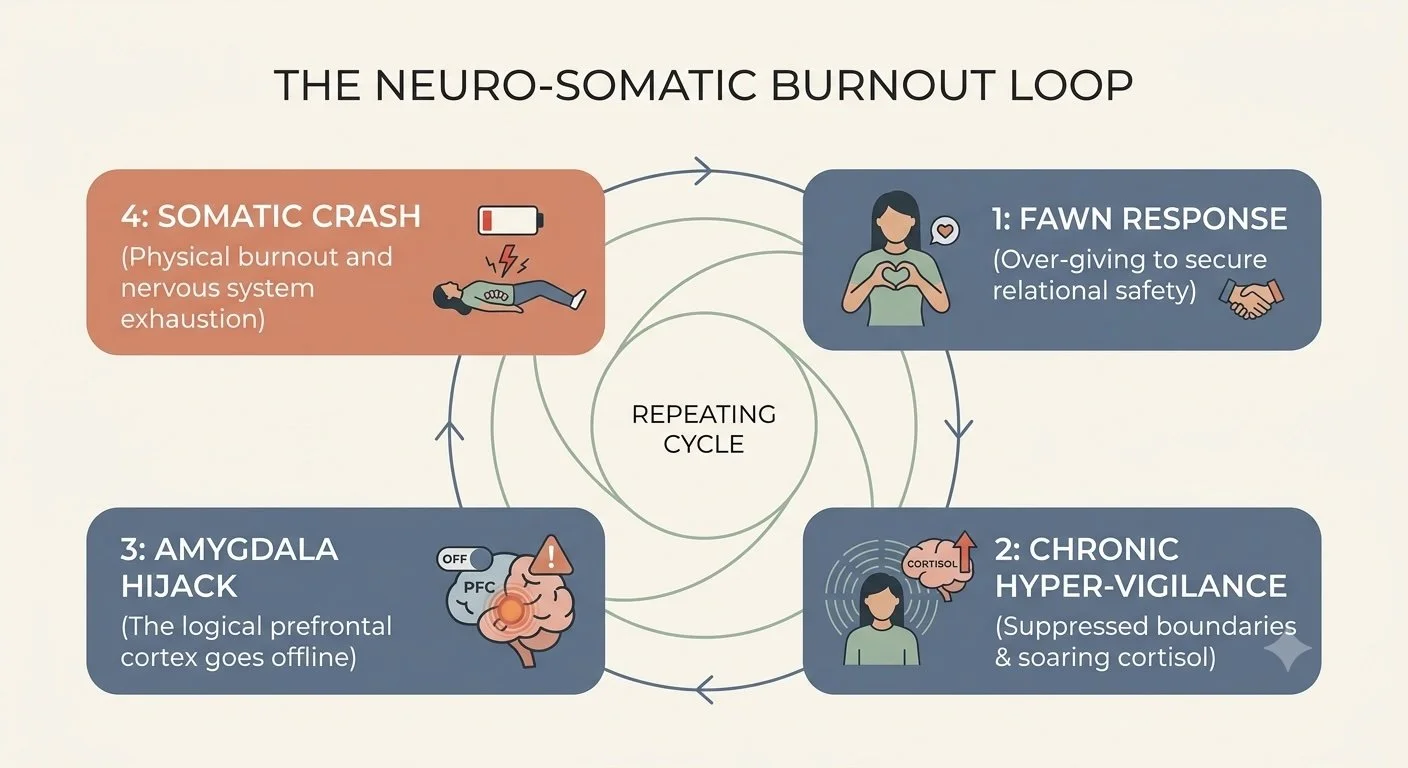
To understand why you can't just "will" your way out of people-pleasing, we have to look below the neck.
Your brain has one primary job: to keep you safe. In our evolutionary history, isolation from the tribe meant death. Because of this, our brains developed survival reflexes to manage conflict.
When a boundary is required, your subcortical brain (the deep, emotional center that controls survival) interprets the potential disapproval of others as a literal physical threat. According to Polyvagal Theory, developed by Dr. Stephen Porges, the autonomic nervous system continuously scans for cues of safety and danger — a process called neuroception — and responds by shifting our biological state before we are ever consciously aware of the threat.
Instead of fight or flight, your system defaults to the fawn response — first named by therapist Pete Walker, this survival strategy recruits your nervous system's social engagement circuitry to appease the perceived danger rather than confront or flee from it.
Fight: Confrontation (which feels far too dangerous).
Flight: Running away (which triggers intense guilt).
Freeze: Numbing out (which happens when burnout is advanced).
Fawn: Pleasing, placating, and over-functioning to neutralize the perceived danger.
When you try to set a boundary, your body experiences a spike of neurological panic. You aren't lacking willpower; your nervous system is actively fighting to protect you.
To heal, we must teach your nervous system that setting a boundary is safe.
Moving Past Talk Therapy: Why Top-Down Approaches Fail for Chronic Over-Givers
For years, traditional talk therapy has relied on Cognitive Behavioral Therapy (CBT). The theory is that if we can change your thoughts, we can change your feelings, which will change your behaviors.
But for chronic people-pleasers, this top-down approach has a massive blind spot.
When you are in a state of nervous system panic, your prefrontal cortex, the logical part of your brain goes offline. Research from Yale School of Medicine confirms that high levels of stress hormones rapidly impair the top-down cognitive functions of the prefrontal cortex while simultaneously strengthening the emotional, survival-based responses of the amygdala. You cannot talk your way out of a physical stress loop.
To create permanent change, we need a bottom-up approach. We must access the deeper, subcortical areas of the brain where these old protection patterns live and process them directly out of the body.
Here is how traditional talk therapy compares to the somatic approaches we use at Anchor Point Counseling:
| Feature / Modality |
Traditional Talk Therapy | EMDR Therapy | Brainspotting |
|---|---|---|---|
| Primary Brain Target | Prefrontal Cortex (Cognitive, Analytical) | Midbrain & Hemispheres (Subcortical) | Midbrain & Autonomic Nervous System (Subcortical) |
| How It Accesses Stress | Verbal processing, analyzing, and reframing thoughts | Rapid bilateral eye movements and structured protocols | Fixed, sustained eye gaze (holding a single "brainspot") |
| Verbal Demands | Very High (requires telling and retelling the story) | Medium (requires structured, periodic cognitive check-ins) | Very Low (focuses entirely on internal bodily processing) |
| Pacing & Setup | Led by cognitive insight and therapist direction | Led by strict, rigid clinical protocol steps | Led entirely by your body's organic self-regulating wisdom |
The Somatic Blueprint: How Brainspotting and EFIT Safely Break the Cycle

As a Licensed Marriage and Family Therapist (LMFT #MFT.2080) with over 7 years of specialized clinical experience, I have watched hundreds of women try to analyze their anxiety away. It doesn't work.
What does work is pairing deep, compassionate relational counseling with body-focused processing. At Anchor Point Counseling, I rely on two highly effective, evidence-based approaches to help you heal: Brainspotting and Emotionally Focused Individual Therapy (EFIT).
Releasing Subcortical Trauma Patches with Brainspotting
Brainspotting therapy is a therapy tool that uses your visual field to locate, process, and release trauma and tension held within the subcortical brain.
"Where you look affects how you feel."
When you feel the panic of setting a boundary, that feeling is anchored to a specific neuro-physical loop. By finding the precise eye position (the "brainspot") that corresponds to that internal activation, we can bypass your analytical mind and allow your brain to heal the pattern from the inside out. A peer-reviewed clinical study published in the Mediterranean Journal of Clinical Psychology found that Brainspotting produced significant reductions in PTSD symptoms, establishing it as an effective evidence-based alternative to EMDR for trauma treatment.
It allows your body to finally digest the old, stuck feelings of guilt, fear, and responsibility, freeing up massive amounts of physical and emotional energy.
Rewiring Attachment Security Through EFIT
While Brainspotting processes the physical charge, Emotionally Focused Individual Therapy (EFIT) heals the relational blueprint.
EFIT, developed by Dr. Susan Johnson and backed by over 30 years of peer-reviewed research through the International Centre for Excellence in Emotionally Focused Therapy, helps you explore and reshape your internal models of attachment. Many chronic people-pleasers learned early in life that love and safety are conditional on performance. We work together to transform those beliefs.
I don't just talk about your past. We actively work in the present moment to help you connect with your emotions, validate your needs, and build a secure, steady relationship with yourself.
Reclaim Your Peace: Free 15-Minute Consultation
You don't have to stay trapped in the exhausting cycle of over-giving. Let's work together to quiet the mental noise, regulate your nervous system, and build unstoppably authentic confidence.
I offer in-person therapy at my quiet Lone Tree, CO office and virtual therapy throughout the state of Colorado.
Schedule your free 15-minute consultation with Anchor Point Counseling
Reclaiming Your Voice: Practical Boundaries for High-Achieving Women
To help your nervous system practice safety, we start small. You do not need to immediately confront your most difficult relationship. You simply need to practice giving your body a moment of pause.
To help your nervous system practice safety, we start small by introducing a physical space between the request and your response.
Step 1: The Somatic Pause
Before responding to a request, place one hand on your chest and take a slow, deep breath. Notice the urge to say "yes" immediately to relieve your anxiety. Do not act on it yet.
Step 2: Buy Yourself Time
Never agree to a non-urgent request on the spot. Practice using a "buffer script" to give your nervous system space to settle.
"Let me check my calendar and capacity and get back to you by tomorrow.""I want to give this the attention it deserves, so let me think about this and let you know."
Step 3: Utilize "Guilt-Shield" Scripts
When you are ready to say no, keep it short, kind, and direct. Do not over-explain, lie, or justify. Over-explaining is a sign of fawning, as it invites the other person to negotiate your boundary.
For Professional Over-Commitment: "Thank you for thinking of me for this project. I don't have the capacity to take this on right now while maintaining my current focus, but I look forward to supporting our team in other ways."
For Relational Requests: "I would love to help you move, but I am prioritizing some quiet rest this weekend so I can recharge. I'm cheering you on from afar!"
For Protecting Your Personal Space: "I value our relationship too much to rush this conversation. I can't talk right now, but let's connect for an hour on Thursday afternoon."
Remember: No is a complete sentence. Your boundary is an invitation for others to respect your limits, not an attack on their character.
Frequently Asked Questions About People-Pleasing and Burnout Recovery
How do I know if I am a people-pleaser or just a kind person?
Kindness is a conscious choice made from a place of abundance, while people-pleasing is a reactive, fear-based survival response. If your giving comes with a cost of internal resentment, physical exhaustion, or a loss of your own identity, it is people-pleasing, not kindness.
How long does it take to heal from severe burnout?
How long it takes depends heavily on how long your system has been running dry. While cognitive strategies can take months of daily management, combining somatic approaches like Brainspotting with deep relational therapy can help settle your nervous system panic in a matter of weeks, allowing your physical energy to recover naturally.
Can I set boundaries and still be a loving partner or friend?
Yes. Setting boundaries is actually the most loving thing you can do for a relationship. When you say "yes" out of fear, you build hidden resentment, which slowly erodes your connection. When you set clear, honest boundaries, you prevent resentment and ensure that your "yes" is genuine, safe, and sustainable.
What if the other person gets angry or pushes back when I set a boundary?
Pushback is common when people are used to your automatic "yes." Their anger is usually a reflection of their own discomfort, not proof that you did something wrong. With somatic training, you can learn to stay grounded and breathe through the temporary discomfort of their reaction without cave-in or panic.
How does Brainspotting actually help with people-pleasing and boundary panic?
Brainspotting accesses the subcortical brain where the physiological "fawn" response is stored. By finding the precise eye position linked to your boundary anxiety, we can safely release the stored somatic charge of guilt and panic. This rewires your nervous system to view limit-setting as a safe, natural action rather than a life-or-death threat.
Your Next Step Toward Freedom
Healing does not mean you turn into a cold, unfeeling person who snaps a "no" at everyone. It means learning to respect your own limits so your generosity actually comes from a full well, rather than a place of silent resentment. You deserve to feel safe in your body and steady in your decisions.
If you live in Englewood, Lone Tree, or anywhere in the Denver metro area (or if you prefer the convenience of virtual therapy from anywhere in Colorado) I invite you to reach out. Let's design a recovery path that is as unique as you are.
Contact Anchor Point Counseling today to schedule your free consultation. Let's help you find your anchor.
About the Author
Stephanie Johnson, LMFT (#MFT.2080), is a Licensed Marriage and Family Therapist and clinical director of Anchor Point Counseling in Englewood, Colorado. With over 7 years of specialized experience helping high-achieving women recover from stress, anxiety, and trauma, Stephanie operates from a deeply relational, neuro-affirming, and somatic-focused framework. She helps clients regulate their nervous systems, establish life-giving boundaries, and step into sustainable, authentic confidence. Read more about her work and approach on her About Page.
Medical Disclaimer: The information provided in this article is intended for educational, informational, and general wellness purposes only and does not constitute medical or mental health advice, diagnosis, or treatment. Always consult with a licensed psychotherapist, physician, or other qualified healthcare provider regarding any psychological symptoms or physical conditions. Never disregard professional medical advice or delay seeking treatment because of something you have read in this article.
Crisis Support Resources: If you are experiencing a mental health crisis, feeling unsafe, or are in immediate danger of self-harm, please reach out to one of the following free, confidential, 24/7 emergency support lines: National Suicide & Crisis Lifeline: Call or text 988 | Emergency Services: Call 911 (or go to your nearest emergency room) | The Crisis Text Line: Text HOME to 741741
