Marriage & Couples Counseling in Englewood, CO: Signs It's Time to Reconnect
Quick Summary
Relationship friction is not a personal failure: Chronic arguments, emotional distance, and roommate dynamics are nervous system survival responses to lost emotional safety, not a lack of communication tools.
Attachment-focused care restores connection: Guided by Emotionally Focused Therapy (EFT) and somatic attunement, couples counseling in Englewood, CO helps partners de-escalate triggers without assigning blame or taking sides.
Proactive support prevents deep resentment: You do not need to wait until your marriage is on the brink of divorce. Addressing subtle communication disconnects early (whether through couples therapy or premarital counseling in Englewood, CO) preserves long-term intimacy.
Accessible care in Englewood and statewide: Meet in person at our Inverness Drive clinic in Englewood, CO, or connect via secure statewide Colorado telehealth.
You stayed up far later than you wanted to last night, running through a fifteen-minute argument in your head for the hundredth time. You catch yourself measuring your words, walking on eggshells, or wondering how two people who love each other deeply ended up feeling like polite roommates sharing a kitchen.
In my years of clinical practice as a Licensed Marriage and Family Therapist in Englewood, I have sat across from hundreds of couples carrying this exact emotional exhaustion. Over 200 couples across Englewood and Denver have sat on our couch feeling this exact way. You are not broken, and neither is your relationship. What you are experiencing isn't a lack of effort; it's a protective adaptation of your nervous system when emotional safety feels compromised. If you want to talk through what is happening before reading further, feel free to schedule a free 15-minute consultation with an Englewood couples therapist.
What Is Attachment-Focused Couples Counseling (and How Does It Work)?
Key Takeaway: Seeking marriage counseling in Englewood, CO or couples therapy in Englewood, CO provides a structured, non-judgmental space to break negative communication loops and rebuild emotional intimacy. Guided by Emotionally Focused Therapy (EFT) and attachment principles, an experienced couples therapist in Englewood, CO helps partners de-escalate nervous system triggers and restore security without assigning blame or taking sides.
At its core, attachment-focused couples counseling recognizes that human beings are hardwired for emotional connection. Neuroimaging research published in PLOS ONE found that after couples completed Emotionally Focused Therapy, partners' brains showed measurably reduced threat activation when facing stress with their partner present. When that connection feels threatened, our survival instincts take over, turning simple daily logistics into intense emotional battles.
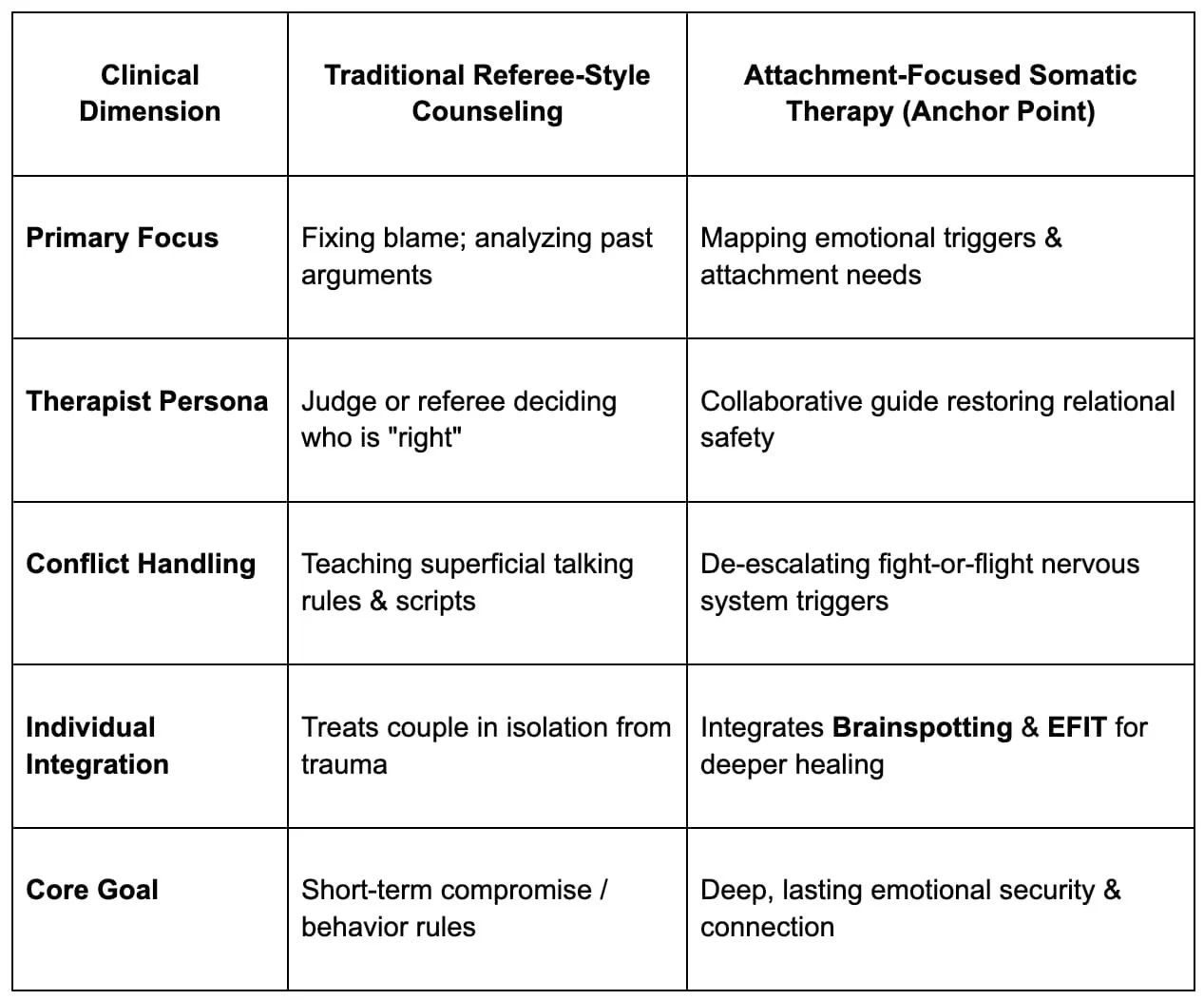
Traditional marriage counseling often treats relationship distress as a skill deficit, offering superficial scripts or communication worksheets. At Anchor Point Counseling Co. in Englewood, CO, we go deeper.
We utilize Emotionally Focused Therapy (EFT) and somatic attunement to help you identify the underlying attachment needs driving your conflicts. Rather than acting as a referee who decides who is "right," we work collaboratively to map your relational cycle. We help you quiet the mental noise, soften nervous system reactivity, and build a safe harbor where both partners feel truly seen, heard, and valued.
How Does Attachment-Based Couples Therapy Differ From Traditional Marriage Counseling?
For decades, traditional couples therapy focused heavily on behavioral modification, conflict resolution rules, or refereeing arguments. Partners were asked to analyze past mistakes, follow rigid talking protocols, or accept arbitrary compromises that left both people feeling misunderstood.
Attachment-based somatic therapy actively dismantles this blame model. We view relationship friction through the lens of nervous system safety and adult attachment security, which is one of the core reasons our specialized relationship counseling in Englewood, CO differs from general counseling.
We treat conflict not as a personality defect, but as a protest against emotional distance. By understanding how your brain and body respond to stress, we create a supportive environment where real emotional repair can occur.
Feeling Exhausted by Repetitive Arguments?
You and your partner deserve a therapeutic relationship where you feel instantly understood and supported without being judged or blamed. Schedule a confidential 15-minute consultation with an Englewood couples therapist today to find your path back to connection.
7 Subtle Signs It's Time for Couples Counseling in Englewood, CO
Many couples delay seeking therapy for years because they believe counseling is reserved only for relationships on the edge of divorce. U.S. Census Bureau data puts Colorado among the highest-marriage states in the country (20.9 marriages per 1,000 women aged 15 and older in 2022, against a national rate of 16.7). A lot of Colorado couples are building long partnerships here, and long partnerships naturally accumulate quiet friction over time.
Addressing subtle communication disconnects early is a proactive health measure, not an admission of failure. Here are 7 clinical signs that your relationship could benefit from attachment-focused couples support:
1. The Pursuer-Withdrawer Cycle (Replaying the Same Fight)
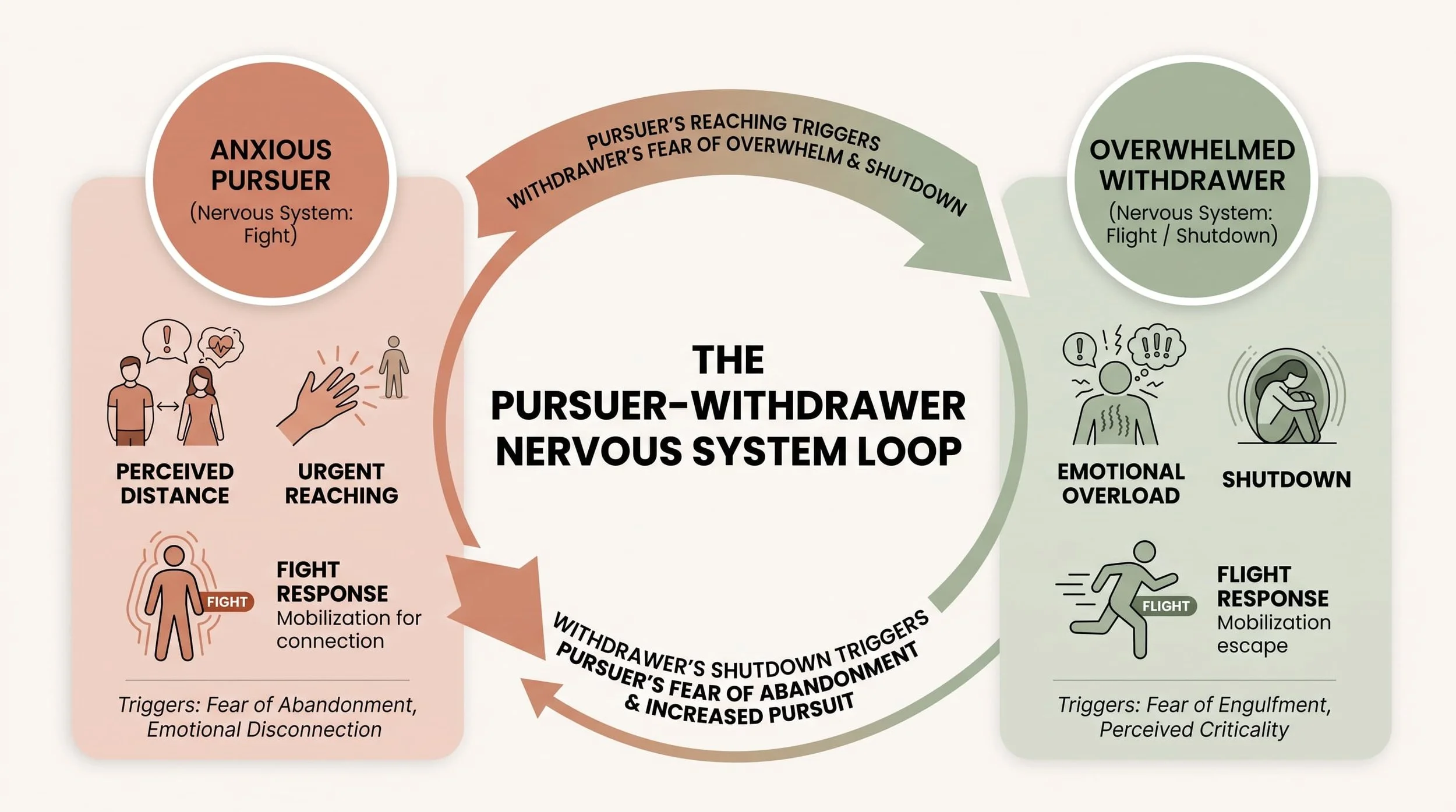
Do you find yourselves arguing about the exact same issue—laundry, scheduling, finances, or parenting over and over without resolution? This classic dynamic is known as the Pursuer-Withdrawer loop. Clinical research comparing distressed and non-distressed couples found that the more rigid this demand-withdraw cycle becomes, the greater the relational distress. One partner feels an anxious urgency to solve the disconnect immediately, while the other feels overwhelmed and shuts down to protect the peace.
2. The Silent Roommate Drift (Living Parallel Lives)
You get along fine on a surface level, managing household chores and kid schedules with mechanical efficiency. But the romantic spark, emotional depth, and playful intimacy have quietly vanished. You feel like polite roommates living parallel lives under one roof. When that flatness spreads beyond the relationship into work, sleep, or motivation, counseling for depression in Englewood, CO can run alongside your couples work.
3. The Over-Functioning Burnout Loop (Resentment from Over-Giving)
In many high-achieving partnerships, one partner gradually absorbs the emotional and mental load of the relationship. You say "yes" to avoid conflict, manage every detail, and suppress your own needs until high-functioning anxiety turns into overwhelming emotional burnout and quiet resentment. We explore this pattern in depth in the hidden cost of people-pleasing, and treat it directly through counseling for people-pleasing in Englewood.
4. Somatic Panic & Nervous System Reactivity During Arguments
When a disagreement starts, do you feel your heart racing, your throat tightening, or an overwhelming urge to flee the room? This isn't poor communication; it's your midbrain entering a fight-or-flight survival state. Psychophysiological research on married couples found that higher physiological arousal during conflict predicted declines in relationship satisfaction three years later. Conversely, a University of Wisconsin neuroimaging study on partner hand-holding showed that holding a supportive partner's hand reduced neural threat activation—proving co-regulation is a biological event. That is why we often pair couples work with Brainspotting therapy in Englewood, CO to release stored survival responses.
5. Unspoken Relational Anxiety & Fear of Abandonment
Do you constantly scan your partner's tone, text messages, or body language for signs of disapproval or withdrawal? Living with chronic relational anxiety makes it terrifying to voice your true needs, leading to constant overthinking and internal spiraling. If you are unsure whether what you feel is stress or something more, start with how to know if it's anxiety, then explore counseling for anxiety in Englewood, CO.
6. Major Life Transitions Straining Your Partnership
Significant life changes such as welcoming a new baby, relocating to Englewood or the Denver metro area, navigating career stress, or adjusting to an empty nest can destabilize established relationship rhythms and expose hidden attachment gaps. An eight-year prospective study on the transition to parenthood found that the arrival of a first child produced a sudden, lasting deterioration in relationship functioning for most couples, which is a normal structural shift rather than a sign that your partnership is failing.
7. Trust Violations, Infidelity, or Considering Separation
Whether you are recovering from emotional or physical infidelity, broken promises, or long-term emotional neglect, rebuilding trust requires expert clinical guidance. Attachment therapy provides a structured container to process hurt and establish true relational repair.
If you recognized your relationship in even two or three of these signs, that is enough of a reason to begin—whether as a routine seasonal relationship check-in or a proactive decision to protect your partnership. The next step is small and low-pressure: book a free 15-minute consultation with an Englewood couples therapist and we will help you decide whether couples counseling, premarital work, or individual support fits your situation best.
What to Expect in Couples Counseling at Anchor Point Counseling Co.
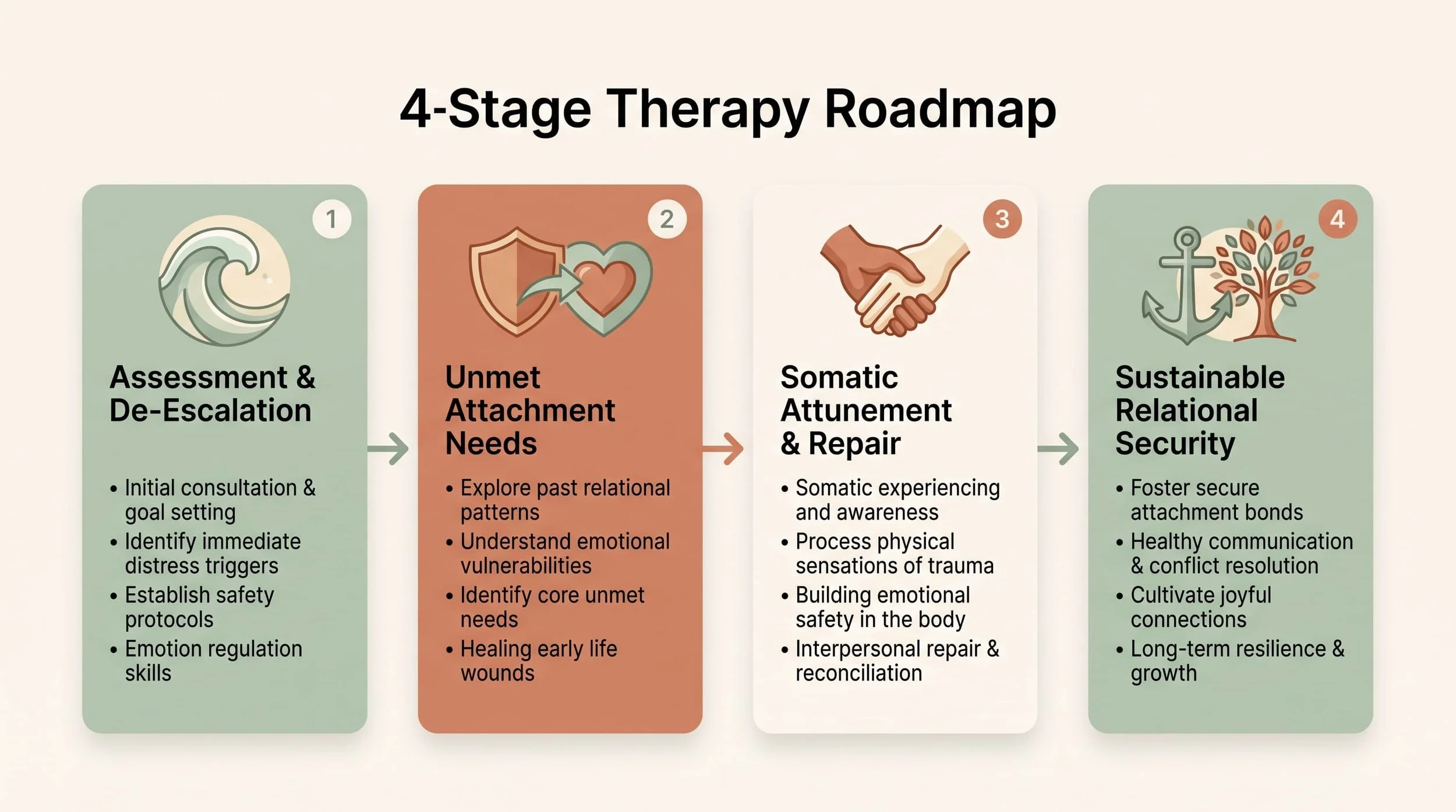
Taking the step to enter therapy together requires immense courage. To help you feel grounded and prepared, we break down our relational reconnection process into four clear, compassionate steps:
Stage 1: Assessment & De-Escalation
We begin by establishing a non-judgmental environment where both partners feel safe. We map out your recurring conflict cycles, identifying the exact moments where emotional misattunement triggers defensive reactions. Our immediate goal is to help you stop the cycle from spiraling.
Stage 2: Identifying Unmet Attachment Needs
Once reactivity lowers, we explore what lies beneath the surface. Fights about dishes are rarely about dishes; they are about feeling valued, supported, and safe. We help you articulate your primary emotional longings without fear of criticism.
Stage 3: Somatic Attunement & Communication Repair
Utilizing Emotionally Focused Therapy (EFT) alongside individual somatic tools like Brainspotting, we guide you through emotional repair in real time. You learn how to stay grounded in your body during difficult conversations and reach for your partner with authentic vulnerability.
Stage 4: Sustainable Relational Security
As new connection patterns take root, we focus on long-term resilience. We help you cultivate meaningful relationship rituals, deepen physical intimacy, and navigate future life transitions as a cohesive, supportive team.
What If My Partner Is Hesitant or Resistant to Couples Therapy?
It is completely normal for one partner to feel hesitant about starting therapy. Often, resistance comes from a fear of being blamed, ganged up on, or told that they are the problem in the relationship.
In our clinical practice, we never use therapy as an arena for finger-pointing. We reassure hesitant spouses that our client is not just one person, our client is the relationship itself. This is the defining stance of the American Association for Marriage and Family Therapy (AAMFT), treating relationships as the unit of care.
If your partner is not ready to attend, starting with Emotionally Focused Individual Therapy (EFIT) or individual counseling allows you to understand your own relational patterns, establish clear boundaries, and invite positive change into your partnership.
How Online Couples Therapy Works Across Colorado
While our physical clinic is located in Englewood, CO (near Inverness Drive), we recognize that busy work schedules, childcare, or commuting across Denver traffic can make in-person appointments challenging.
Through secure, HIPAA-compliant telehealth, we provide online couples therapy for clients across Denver, Greenwood Village, Littleton, and statewide Colorado.
Benefits of Telehealth Couples Counseling in Colorado:
Comfort & Privacy: Join sessions together from the comfort of your couch in a familiar, safe environment.
Flexible Scheduling: Easily integrate therapy into your workweek without commuting across the Denver metro area.
Consistent Progress: Maintain regular session momentum even during travel, bad weather, or busy family routines.
Frequently Asked Questions About Couples Counseling in Englewood
How do I know if we need marriage counseling in Englewood, CO or individual therapy?
If your primary distress stems from recurring conflict loops, emotional distance, or feeling like roommates, couples therapy in Englewood, CO addresses the relationship directly. If one partner is struggling with individual trauma or anxiety that spills into the partnership, pairing couples work with individual therapy or Brainspotting often yields the best results.
How long does relationship counseling in Englewood, CO typically take to see results?
Every relationship is unique. However, because Emotionally Focused Therapy (EFT) is a structured, evidence-based modality recognized by the International Centre for Excellence in Emotionally Focused Therapy (ICEEFT), many couples experience meaningful de-escalation and emotional relief within 8 to 20 sessions.
What if my partner is hesitant or resistant to starting therapy?
Partner resistance usually stems from a fear of being blamed, ganged up on, or singled out as the problem. In attachment-based therapy, the relationship itself is treated as the client, avoiding finger-pointing or taking sides. If your partner remains unwilling to attend, starting with Emotionally Focused Individual Therapy (EFIT) or individual counseling allows you to begin shifting relational patterns on your own.
How does attachment-focused therapy differ from traditional marriage counseling?
Traditional counseling often relies on fixing blame, refereeing past arguments, and enforcing talking rules or behavioral scripts. Attachment-focused somatic therapy views conflict as a fight-or-flight response to lost emotional safety, working instead to map underlying triggers and restore deeper connection.
Do we need to wait until our relationship is on the brink of divorce to get support?
No, proactive support prevents quiet friction from turning into deep resentment. Addressing subtle communication disconnects early whether through seasonal relationship check-ins, premarital counseling, or couples therapy preserves long-term intimacy before a crisis occurs.
Is online couples therapy available if we cannot attend in person?
Yes, secure HIPAA-compliant telehealth is available for clients across Denver, Greenwood Village, Littleton, and statewide Colorado. Virtual sessions allow couples to join from the comfort of their home, accommodating busy schedules and avoiding Denver metro traffic while keeping momentum consistent.